Vjekoslav Karas (?)
Rome, circa 1850
oil on canvas, no signature
the gift of Marta Durst, 1963
inv. no.: 460
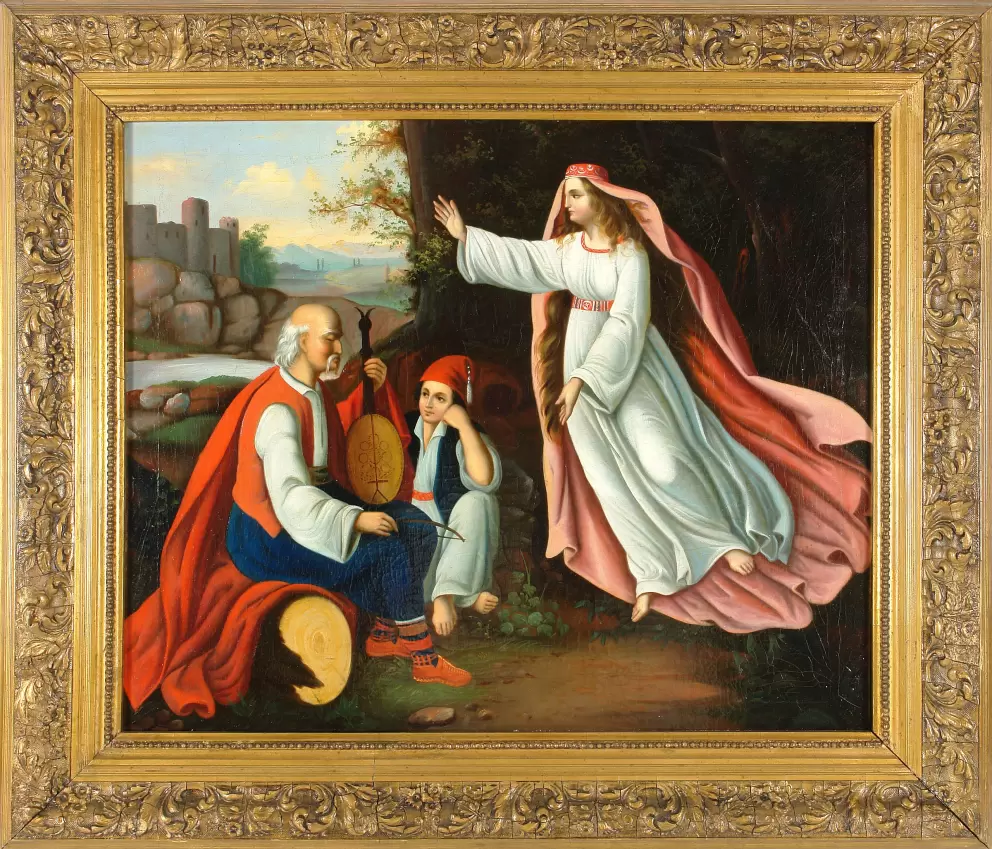
The painting on display, cataloged in the Typhlological Museum as The Blind Man and the Fairy, was painted by Vjekoslav Karas in Rome around 1850. Vjekoslav Karas is considered the most significant representative of 19th-century Croatian painting. Born in Karlovac, he studied painting in Florence and Rome. Karas worked in oil on canvas, watercolors, and drawings, with his works featuring elements of Baroque, Neoclassicism, and Romanticism. He has been referred to as the "first Illyrian painter". His portfolio includes portraits, figures, genre scenes from folk life, and landscapes. The Blind Man and the Fairy was created during his time in Italy as an expression of patriotic sentiment. It is an oil painting on canvas, gifted to the Typhlological Museum by Marta Durst, Vinko Bek's daughter, in 1963.
The painting portrays three figures in the foreground: a grandfather, an elderly blind man playing a fiddle, and his grandson, who is attentively listening, alongside a fairy hovering in the air. These figures form the central composition, inspired by early Renaissance masters. They are situated in a meadow in front of a dense and dark forest, with a view opening on the left to a sunlit landscape featuring a distant medieval castle. Karas depicted the fairy as a muse, inspiring the elderly fiddler with heroic folk songs, while the grandson listens, ready to pass on the tradition.
This painting is placed at the beginning of the section on the Development of the Script for the Blind and reflects society's historical attitude towards the blind, suggesting that written language was unnecessary for them as all knowledge could be transmitted orally, as demonstrated through storytelling and fiddle playing.
The Blind Man and the Fairy (Grandfather, Grandson, and the Fairy)
Vjekoslav Karas (?)
Rome, circa 1850
oil on canvas, no signature
the gift of Marta Durst, 1963
inv. no.: 460
The painting on display, cataloged in the Typhlological Museum as The Blind Man and the Fairy, was painted by Vjekoslav Karas in Rome around 1850. Vjekoslav Karas is considered the most significant representative of 19th-century Croatian painting. Born in Karlovac, he studied painting in Florence and Rome. Karas worked in oil on canvas, watercolors, and drawings, with his works featuring elements of Baroque, Neoclassicism, and Romanticism. He has been referred to as the "first Illyrian painter". His portfolio includes portraits, figures, genre scenes from folk life, and landscapes. The Blind Man and the Fairy was created during his time in Italy as an expression of patriotic sentiment. It is an oil painting on canvas, gifted to the Typhlological Museum by Marta Durst, Vinko Bek's daughter, in 1963.
The painting portrays three figures in the foreground: a grandfather, an elderly blind man playing a fiddle, and his grandson, who is attentively listening, alongside a fairy hovering in the air. These figures form the central composition, inspired by early Renaissance masters. They are situated in a meadow in front of a dense and dark forest, with a view opening on the left to a sunlit landscape featuring a distant medieval castle. Karas depicted the fairy as a muse, inspiring the elderly fiddler with heroic folk songs, while the grandson listens, ready to pass on the tradition.
This painting is placed at the beginning of the section on the Development of the Script for the Blind and reflects society's historical attitude towards the blind, suggesting that written language was unnecessary for them as all knowledge could be transmitted orally, as demonstrated through storytelling and fiddle playing.