Mecker
Germany, 1889
wood, aluminum
the gift of the Institute for the Blind, Radnička street, 1953
inv. no.: 27
The writing slate is an aid for writing in Braille. It was made in Germany in 1889 and was gifted to Vinko Bek by W. Mecker, the director of the Institute for the Blind in Düren, Germany. It was later found at the Institute for the Blind on Radnička Street in Zagreb, which donated it to the Typhlological Museum in 1953.
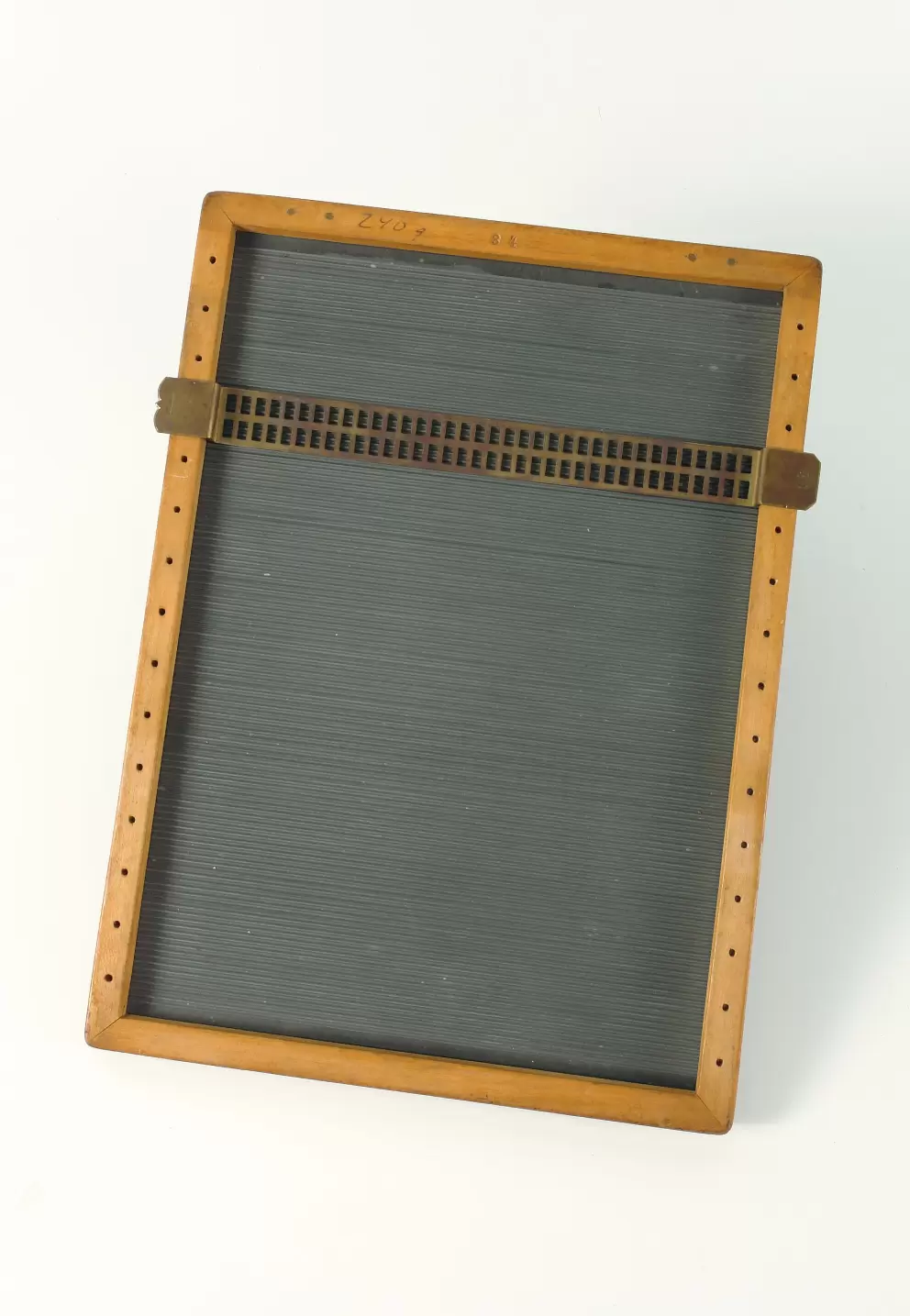
This tool belongs to the category of grooved slates. It consists of three parts: an aluminum grooved slate and a wooden frame attached to it, which holds the paper in place and secures it. A double-row frame with rectangular openings, designated for imprinting Braille letters, is inserted into the wooden frame. The letters are embossed using a stylus, and the board can accommodate 24 rows of text.
The earliest Braille writing slates were grooved. Initially made of wood and later of metal, the writing process required the use of a stylus, and the text had to be written in reverse. A great deal of skill was needed to emboss the raised dots in precisely the correct position to form the Braille letters.
Writing slate
Mecker
Germany, 1889
wood, aluminum
the gift of the Institute for the Blind, Radnička street, 1953
inv. no.: 27
The writing slate is an aid for writing in Braille. It was made in Germany in 1889 and was gifted to Vinko Bek by W. Mecker, the director of the Institute for the Blind in Düren, Germany. It was later found at the Institute for the Blind on Radnička Street in Zagreb, which donated it to the Typhlological Museum in 1953.
This tool belongs to the category of grooved slates. It consists of three parts: an aluminum grooved slate and a wooden frame attached to it, which holds the paper in place and secures it. A double-row frame with rectangular openings, designated for imprinting Braille letters, is inserted into the wooden frame. The letters are embossed using a stylus, and the board can accommodate 24 rows of text.
The earliest Braille writing slates were grooved. Initially made of wood and later of metal, the writing process required the use of a stylus, and the text had to be written in reverse. A great deal of skill was needed to emboss the raised dots in precisely the correct position to form the Braille letters.