J. W. Klein
Vienna, late 19th century
wood, metal
the gift of the Institution for the Blind in Radnička street, Zagreb, 1953
inv. no.: 104
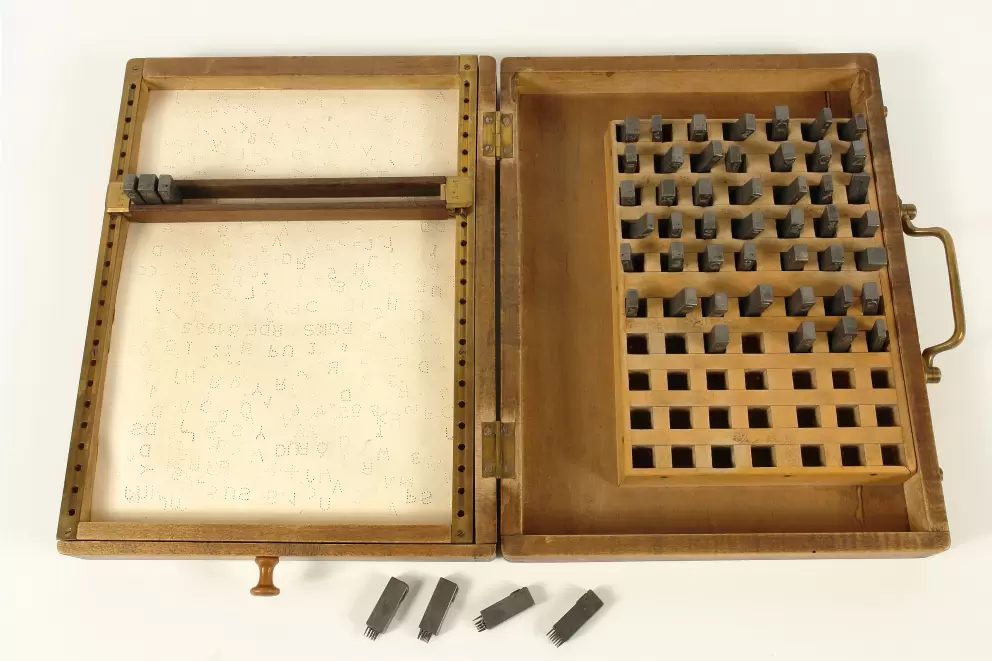
The Klein apparatus is a device for writing in needle script or Klein type, designed by Johann Wilhelm Klein in 1809 in Vienna for his blind students. It consists of two wooden sides that close to form a box. The left side contains the main frame with perforated brass guides and a felt base where the paper for writing is placed. The right side features a wooden grid in which letter molds, made as lead rectangular prisms, are set, marked with embossed letters and needle ends. By arranging the prisms in the movable frame and applying pressure, a text is produced on the reverse side of the paper, written in large Latin letters, which is both visible and readable by touch.
The device was made in Vienna in the late 19th century and was donated to the Typhlological Museum in 1953 by the Institute for the Blind on Radnička Street in Zagreb.
The Klein apparatus
J. W. Klein
Vienna, late 19th century
wood, metal
the gift of the Institution for the Blind in Radnička street, Zagreb, 1953
inv. no.: 104
The Klein apparatus is a device for writing in needle script or Klein type, designed by Johann Wilhelm Klein in 1809 in Vienna for his blind students. It consists of two wooden sides that close to form a box. The left side contains the main frame with perforated brass guides and a felt base where the paper for writing is placed. The right side features a wooden grid in which letter molds, made as lead rectangular prisms, are set, marked with embossed letters and needle ends. By arranging the prisms in the movable frame and applying pressure, a text is produced on the reverse side of the paper, written in large Latin letters, which is both visible and readable by touch.
The device was made in Vienna in the late 19th century and was donated to the Typhlological Museum in 1953 by the Institute for the Blind on Radnička Street in Zagreb.