Vinko Bek
Zagreb, 1896
paper, sting writing
inv. no.: 418
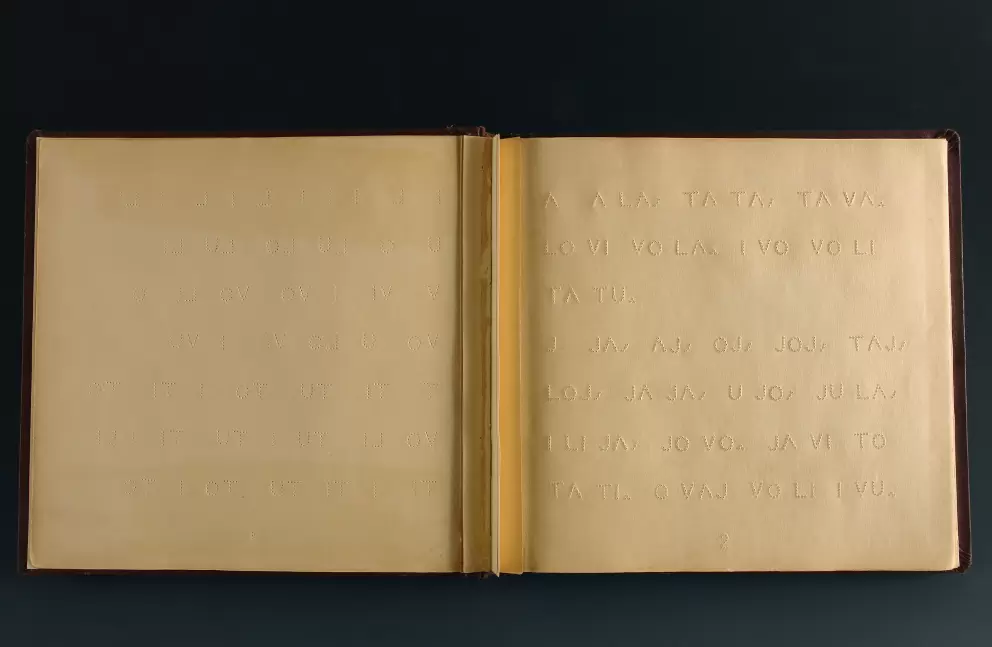
The Primer from 1896, authored by Vinko Bek, was printed in Zagreb using needle printing or Klein type. This primer was donated to the Typhlological Museum in 1954 by the Institute for the Education of Blind Children in Zagreb.
The needle type was invented by Johann Wilhelm Klein, the founder of the first school for the blind in Vienna, who introduced needle printing (later called Klein type) in 1809. This system was based on embossed Latin letters formed by small needles arranged to give a complete tactile representation of each letter. Reading this script by touch was time-consuming, and a major drawback was that the blind could not write it themselves.
This alphabet met Klein’s primary criterion—that it closely resemble the standard alphabet used by sighted people. Klein's resistance to adopting Braille’s system stemmed from his belief that it was not compatible with the alphabet used by the sighted. It took 40 years for Braille's script to gain acceptance in German-speaking countries.
Primer
Vinko Bek
Zagreb, 1896
paper, sting writing
inv. no.: 418
The Primer from 1896, authored by Vinko Bek, was printed in Zagreb using needle printing or Klein type. This primer was donated to the Typhlological Museum in 1954 by the Institute for the Education of Blind Children in Zagreb.
The needle type was invented by Johann Wilhelm Klein, the founder of the first school for the blind in Vienna, who introduced needle printing (later called Klein type) in 1809. This system was based on embossed Latin letters formed by small needles arranged to give a complete tactile representation of each letter. Reading this script by touch was time-consuming, and a major drawback was that the blind could not write it themselves.
This alphabet met Klein’s primary criterion—that it closely resemble the standard alphabet used by sighted people. Klein's resistance to adopting Braille’s system stemmed from his belief that it was not compatible with the alphabet used by the sighted. It took 40 years for Braille's script to gain acceptance in German-speaking countries.