Mosinger and Breyer
Zagreb, early 20th century
paper, photograph, sepia
inv. no.: 3199
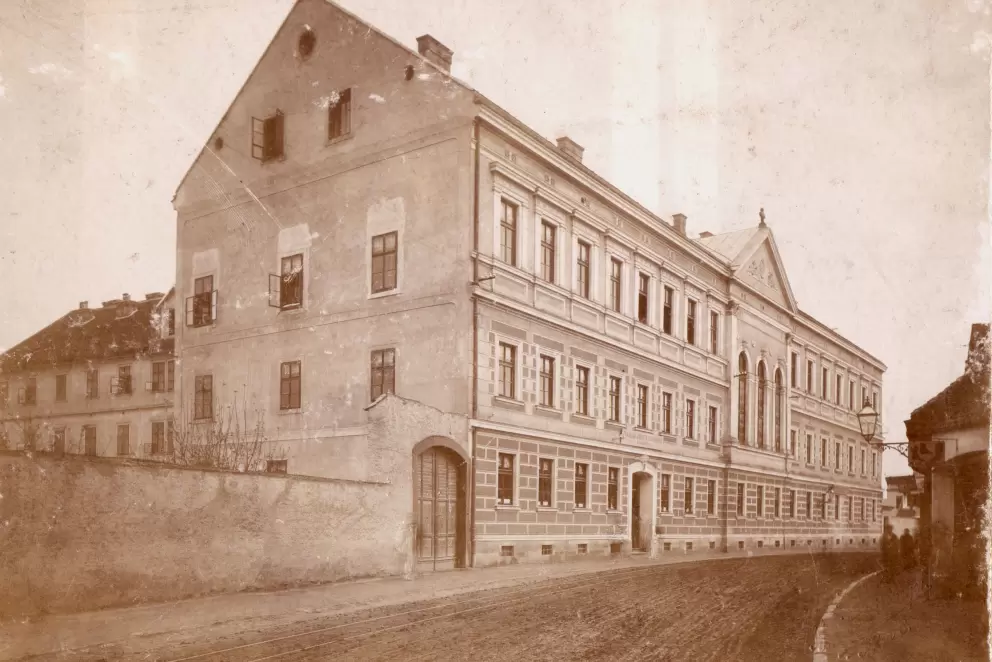
The displayed photograph is an enlarged photograph of the building that housed the National Institute for the Education of Blind Children, in Ilica 83. The photograph was taken in early 20th century and was developed at the Mosinger and Breyer photography studio.
One part of the building housed the Institute for the Deaf-mute, a maternity ward was placed in another part, and the Institute for the Education of Blind Children spread over only eight rooms on the ground floor. At the beginning there was only one dormitory for boys and one for girls, a classroom for the second grade and a headmaster’s office that contained a library, museum, collection of teaching aids, the teacher’s living quarters, two small rooms for cleaning and washing, and a room in which the visitors could come and talk to their children.
The Institute accepted visually impaired boys and girls who were physically and mentally developed and between the age of 7 and 12. In the beginning members of the pedagogical staff were only Vinko Bek and teacher Flora Floegel. Due to restricted and inadequate space, the Institute could not accept more children, so in the first years the Institute had only 26 children each year.
The building of the National Institute for the Education of Blind Children in Zagreb
Mosinger and Breyer
Zagreb, early 20th century
paper, photograph, sepia
inv. no.: 3199
The displayed photograph is an enlarged photograph of the building that housed the National Institute for the Education of Blind Children, in Ilica 83. The photograph was taken in early 20th century and was developed at the Mosinger and Breyer photography studio.
One part of the building housed the Institute for the Deaf-mute, a maternity ward was placed in another part, and the Institute for the Education of Blind Children spread over only eight rooms on the ground floor. At the beginning there was only one dormitory for boys and one for girls, a classroom for the second grade and a headmaster’s office that contained a library, museum, collection of teaching aids, the teacher’s living quarters, two small rooms for cleaning and washing, and a room in which the visitors could come and talk to their children.
The Institute accepted visually impaired boys and girls who were physically and mentally developed and between the age of 7 and 12. In the beginning members of the pedagogical staff were only Vinko Bek and teacher Flora Floegel. Due to restricted and inadequate space, the Institute could not accept more children, so in the first years the Institute had only 26 children each year.